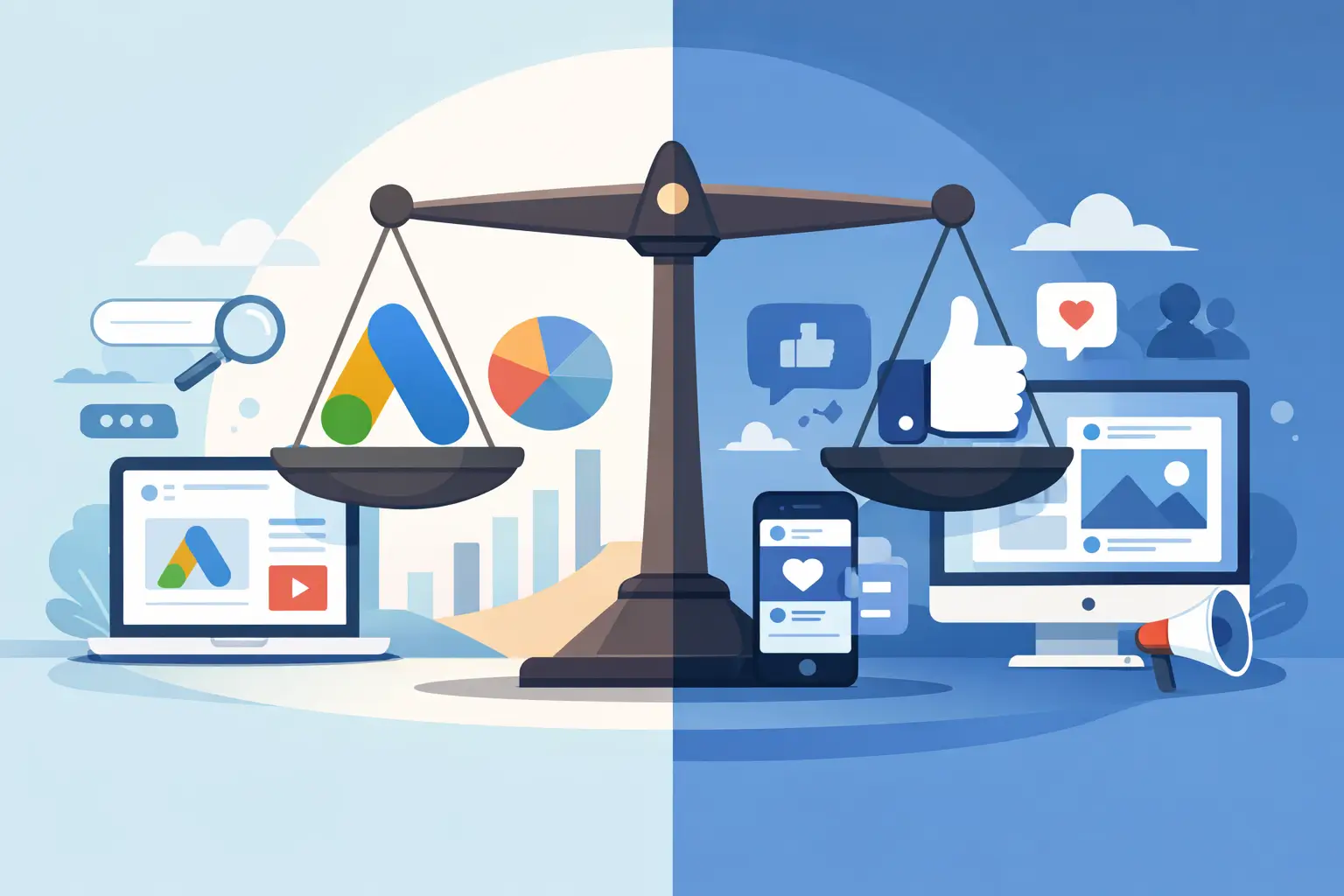
If you are weighing google ads vs facebook ads, you are probably not looking for a textbook answer. You want to know where your money should go, what kind of lead or sale each platform can realistically produce, and how to avoid wasting budget on the wrong channel. That is the right question to ask, because these platforms do very different jobs.
Many businesses come into paid media assuming one platform is simply better than the other. In practice, the better option depends on your sales cycle, your offer, your audience behavior, and how ready your market is to buy. The strongest results usually come from choosing the platform that matches your current business objective, not from following a trend.
Google Ads vs Facebook Ads: The core difference
The biggest difference between Google Ads and Facebook Ads is intent.
Google Ads reaches people who are actively searching. They have a need, a question, or a problem, and they are typing it into Google right now. If someone searches for “commercial roofing company near me” or “best payroll software for small business,” that person is already raising a hand.
Facebook Ads, which also includes Instagram placements through Meta, works differently. It puts your message in front of people based on demographics, interests, behaviors, and past activity. They may be a strong fit for your business, but they were not necessarily looking for you at that moment. You are creating demand, not just capturing it.
That distinction matters because it affects everything else – cost, conversion rate, creative strategy, sales timing, and how patient you need to be.
When Google Ads makes more sense
Google Ads is often the stronger choice when demand already exists and your audience knows what they need. That is especially true for local services, urgent needs, high-intent B2B searches, and businesses with clear search terms tied to revenue.
If you are a law firm, HVAC company, dentist, IT provider, or niche B2B service, Google often gives you access to prospects who are much closer to a decision. These users are comparing options, reading reviews, and preparing to take action. A well-structured search campaign can put you in that conversation at exactly the right time.
Google Ads can also be easier to justify from a direct response standpoint. The path from search to click to form fill or phone call is more straightforward. For businesses that need lead generation now, that matters.
Still, Google has limits. Search volume is only as big as the market searching for your service. If people are not searching for your exact solution, or if your category is new, highly visual, or impulse-driven, Google may not be enough on its own. It can also get expensive in competitive industries, especially when multiple advertisers are bidding on the same high-value keywords.
Google Ads works best for high-intent demand
Google is usually the better fit when your customer knows the problem, is actively researching solutions, and can be persuaded by relevance, trust signals, and a clear offer. It tends to reward strong landing pages, tight keyword targeting, and disciplined campaign structure more than flashy creative.
That is why businesses with established demand often see Google as the faster route to measurable lead quality.
When Facebook Ads makes more sense
Facebook Ads is often the better choice when your audience needs to be educated, nurtured, or inspired before they act. It shines when visual storytelling matters and when buying decisions are influenced by brand familiarity, emotion, or repeated exposure.
This is common in lifestyle brands, e-commerce, coaching, home services with long consideration cycles, events, franchises, and many B2C offers. It also has value for B2B companies when the goal is awareness, audience building, webinar promotion, content distribution, or retargeting.
With Facebook, you are not waiting for someone to search. You are proactively getting in front of the right people and introducing your value at the right angle. That can be powerful, especially if your business solves a problem customers do not immediately search for by name.
The challenge is that Facebook requires stronger messaging and better creative. You are interrupting attention, not responding to it. If the ad is bland, unclear, or poorly targeted, people scroll past it without a second thought.
Facebook Ads works best for audience building
Facebook tends to perform well when your growth depends on building recognition over time. If prospects need to see your brand more than once before converting, Meta’s ecosystem gives you useful tools for awareness, consideration, remarketing, and lead nurturing.
That does not mean it is only a top-of-funnel platform. Plenty of businesses generate leads and sales directly from Facebook. But the wins usually come when campaigns are built around the customer journey, not just a single ad and a hope that it converts.
Cost is not as simple as cheaper clicks
A common question in the google ads vs facebook ads conversation is which platform is cheaper. The honest answer is that cheaper clicks do not always mean better results.
Facebook often has a lower cost per click, but those clicks may come from colder audiences. Google clicks are frequently more expensive, yet those visitors may convert faster because they were already searching.
What matters more is cost per qualified lead, cost per acquisition, and downstream revenue. A $4 click that produces strong leads can outperform a $1 click that brings low-intent traffic. This is where many businesses get misled. They focus on surface metrics instead of business outcomes.
The right platform is the one that brings profitable action, not just inexpensive traffic.
Creative, landing pages, and the real work behind performance
Neither platform works well without the right support system.
Google Ads depends heavily on keyword strategy, search intent alignment, ad copy clarity, and landing page conversion strength. If your page is slow, generic, or disconnected from the search, performance drops quickly.
Facebook Ads leans even harder on creative quality, audience segmentation, and offer positioning. You need strong visuals, persuasive copy, and a clear reason for someone to stop scrolling. Once they click, your landing page still has to do its job.
This is one reason many small and mid-sized businesses struggle with paid media. They think they are choosing between two ad platforms, when they are really choosing between two complete systems. The ad account matters, but so do the message, the design, the funnel, and the follow-up process.
Should you choose one or use both?
For some businesses, the answer is one platform first, then the other.
If you need immediate demand capture and know your customers are searching, start with Google Ads. If you need market education, brand visibility, or retargeting support, Facebook may be the better first investment. But there are many cases where using both creates a stronger, more stable strategy.
A prospect might first encounter your brand on Facebook, visit your site, leave, then come back later through a Google search when they are ready to act. Or they may click a Google ad, compare options, and later convert after seeing your Facebook retargeting ad. That is how real buyer behavior often works.
This is where a phased strategy matters. Instead of forcing all results from one channel, you build a system where each platform supports a different stage of the journey. That is often how sustainable growth happens.
How to decide between Google Ads vs Facebook Ads
Start with your business goal. If your top priority is lead volume from active buyers, Google is often the first place to test. If your priority is visibility, market awareness, or staying in front of a defined audience, Facebook may be the stronger fit.
Next, look at your sales cycle. Shorter sales cycles and urgent needs usually align well with Google. Longer consideration cycles often benefit from Facebook’s ability to build familiarity over time.
Then assess your offer. If people already search for it, Google has an advantage. If they need to be shown why they need it, Facebook may be more effective.
Finally, look at your internal readiness. If you do not yet have strong creative assets, Facebook can be harder to execute well. If your website and landing pages are weak, Google will expose those gaps quickly. In both cases, the platform can only perform as well as the strategy behind it.
At Tind-All Creative Marketing, we often guide businesses through this decision by starting with the outcome first, then building the channel mix around it. That approach keeps the conversation focused on growth, not guesswork.
The best paid media decision is rarely about picking a winner in a blanket debate. It is about choosing the platform that matches your audience, your offer, and your next business objective. When those pieces line up, your ad spend stops feeling risky and starts working like a system. Keep your focus there, and better decisions get much easier.