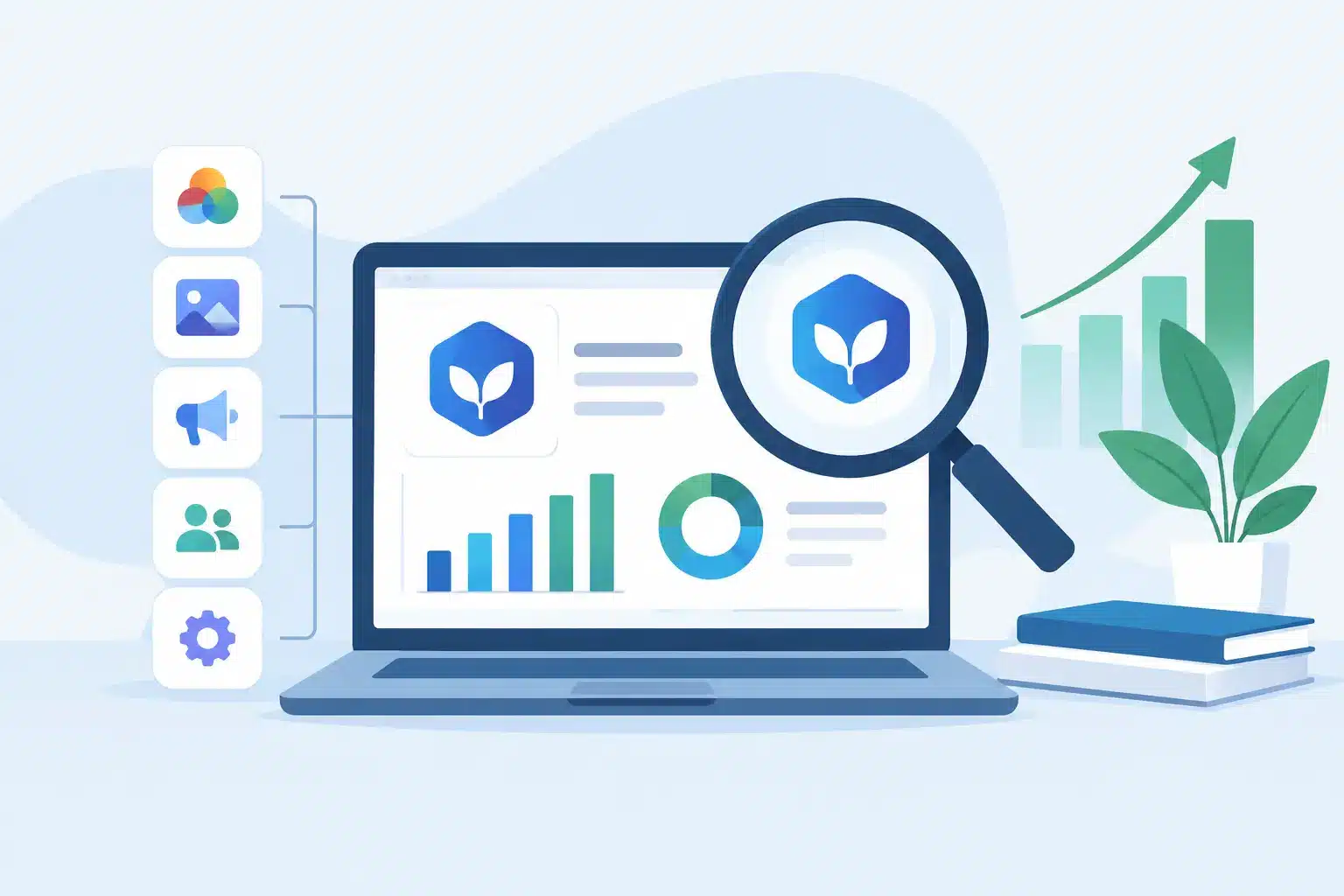
A brand audit should answer a business question, not create a longer to-do list. The best brand audit tools help you see where customers experience confusion, inconsistency, or friction across your website, search presence, social channels, sales materials, and customer conversations. Used with a clear process, they replace assumptions with evidence and give your team a practical path forward.
For small and mid-sized businesses, that matters because marketing resources are rarely unlimited. You need to know whether the first priority is clarifying your message, improving website conversion, correcting inconsistent visuals, protecting your reputation, or investing in the channels that actually support growth.
What a Brand Audit Tool Can – and Cannot – Do
No platform can independently define your brand strategy. A dashboard can show declining organic traffic, uneven engagement, or negative sentiment. It cannot tell you which promise is most believable to your ideal customer or whether your sales team can confidently communicate that promise.
That is why a useful audit combines quantitative data with human context. Review what customers search for, click, say, and do. Then compare those findings against your business goals, competitive position, visual identity, and customer experience. The tools below support that work, but the strategy comes from connecting the dots.
9 Best Brand Audit Tools to Build a Stronger Picture
1. Google Analytics 4
Google Analytics 4 is a foundational tool for understanding how people behave once they reach your website. It can reveal which channels bring qualified visitors, which pages hold attention, and where users leave before taking an action.
For a brand audit, pay close attention to engagement by landing page, conversion paths, returning visitors, and traffic by channel. If visitors arrive through branded search but quickly exit key service pages, your reputation may be stronger than the website experience that is supposed to support it. The trade-off is setup: GA4 is powerful, but poorly configured events and conversions can lead to misleading conclusions.
2. Google Search Console
Search Console shows how your brand appears when people search on Google. It identifies the queries that generate impressions and clicks, the pages being surfaced, and technical issues that may limit visibility.
This is especially valuable for evaluating message-market fit. Do the search terms bringing people to your site match the problems you want to solve? Are customers finding a specific service page, or are they landing on outdated content that no longer reflects your positioning? Search Console is free and essential, although it does not provide the competitor depth of a paid SEO platform.
3. Semrush
Semrush provides a wider view of search visibility, paid search activity, keyword gaps, backlinks, and competitor performance. It is useful when a business needs to understand whether its language and content are competitive within a crowded market.
Use it to compare your visibility with direct competitors, identify topics they own that you have overlooked, and review the health of the pages representing your brand in search. It can also support local businesses through listing and reputation-related features. The platform has a learning curve and its many reports can become distracting without clear audit questions.
4. Ahrefs
Ahrefs is another strong option for researching organic search presence, backlinks, and content opportunities. Its backlink data is particularly useful when an audit needs to examine brand authority, referral sources, and the quality of websites associating with your company.
A sudden loss of quality links, for example, can help explain weaker search performance. Reviewing competitors’ strongest pages can also expose content gaps in your own brand story. Choose Ahrefs when SEO and content authority are major priorities; for teams that need extensive advertising or local listing capabilities, Semrush may be the more practical all-around fit.
5. Hotjar
Hotjar brings customer behavior into focus through heatmaps, session recordings, and on-page feedback tools. It is helpful when the question is not simply whether people visit your website, but whether they understand what to do once they get there.
During a brand audit, watch how visitors interact with your homepage, service pages, and contact forms. Are they scrolling past the value proposition? Clicking elements that are not clickable? Leaving before they reach the proof that builds trust? Heatmaps reveal patterns, not motives, so pair them with customer feedback before changing your messaging or navigation.
6. SurveyMonkey or Typeform
Customer surveys provide something analytics cannot: direct language from the people you serve. SurveyMonkey and Typeform can help collect structured feedback about why customers chose you, what they value most, how they describe your business, and where their experience fell short.
Keep surveys focused. A short set of thoughtful questions will generally produce better responses than a lengthy questionnaire. Ask customers what problem they were trying to solve, what alternatives they considered, and how they would describe your business to a colleague. Their answers can sharpen positioning, testimonials, website copy, and sales conversations.
7. Brandwatch
Brandwatch is a social listening platform designed to track conversations, mentions, sentiment, and trends across digital channels. For businesses with an active public profile, a large customer base, or a reputation-sensitive industry, it can expose themes that routine social reporting misses.
You may learn that customers praise your responsiveness but question your pricing, or that a competitor owns a conversation you assumed was yours. Brandwatch is typically more investment than a smaller organization needs for a simple audit. If your social footprint is limited, native analytics and direct customer interviews may produce enough insight at a lower cost.
8. BuiltWith
BuiltWith identifies technologies used on websites, including analytics platforms, ecommerce systems, advertising tools, and content management systems. It is not a traditional brand tool, but it can add useful competitive context when digital experience is part of the audit.
For example, knowing how competitors support booking, lead capture, chat, personalization, or online sales can inform your own website roadmap. Treat this information as research, not a blueprint. Copying another company’s technology stack will not solve a weak message or an unclear customer journey.
9. Canva Brand Kit or Frontify
A visual consistency review needs a place to examine and organize brand assets. Canva Brand Kit is approachable for smaller teams that need approved colors, fonts, logos, templates, and simple guardrails. Frontify is better suited to organizations that require formal brand guidelines, more complex asset management, and stronger governance across departments.
Both tools can reveal a common issue: the brand may look different in every customer touchpoint because employees are working from old files or making assets from scratch. The right choice depends on team size and approval needs. A simple, adopted system is more useful than an advanced platform no one maintains.
How to Choose the Right Mix of Tools
Avoid buying every platform at once. Start with the business outcome your audit needs to support. If leads are falling, begin with website behavior, search performance, and customer feedback. If your team is struggling with inconsistent presentation, prioritize asset management, a visual review, and clear usage standards. If reputation is the concern, use reviews, surveys, and social listening to understand the full customer experience.
A productive audit usually needs evidence in four areas:
- Brand clarity: What customers believe you do, who you serve, and why they should choose you.
- Brand visibility: How easily customers find you through search, social media, referrals, and local listings.
- Brand experience: Whether your website, sales process, service delivery, and follow-up fulfill the promise your marketing makes.
- Brand consistency: Whether your messaging, visuals, tone, and calls to action work together across every touchpoint.
You do not need a separate tool for every category on day one. Google Analytics 4, Search Console, a customer survey, and a structured review of existing materials can create a strong starting point for many businesses.
Turn Findings Into a Prioritized Brand Plan
The biggest risk in any audit is collecting valuable data and then treating every issue as equally urgent. A better approach is to rank findings by business impact, effort, and confidence. A confusing homepage headline that affects every visitor should usually be addressed before a minor font inconsistency in an internal presentation.
Connect each recommendation to a measurable outcome. Clarifying a service page may support more qualified inquiries. Updating sales collateral may shorten the time it takes prospects to understand your value. Standardizing templates may reduce approval delays and improve consistency across campaigns. This is where a phased plan turns a brand audit from an observation exercise into a growth system.
The best brand audit tools are not necessarily the most expensive or feature-heavy. They are the tools that give your team credible insight, support better decisions, and help you follow through. When the findings are translated into focused action, your brand becomes easier to recognize, easier to trust, and easier for customers to choose.


Leave a Reply
Your email is safe with us.