If your marketing budget feels stretched, the question is rarely whether SEO or PPC works better in general. The real question is how seo vs ppc budgeting should work for your business, your sales cycle, and your growth goals right now. A company that needs leads this quarter will make different decisions than one building long-term visibility in a competitive market – and both can be right.
That is where many businesses get stuck. They hear that SEO builds lasting value and PPC gets fast traffic, but they are not given a clear framework for deciding how much to invest in each. Without that framework, budget choices become reactive. You spend more on ads when leads slow down, then pull back too far, then wonder why organic traffic has not filled the gap.
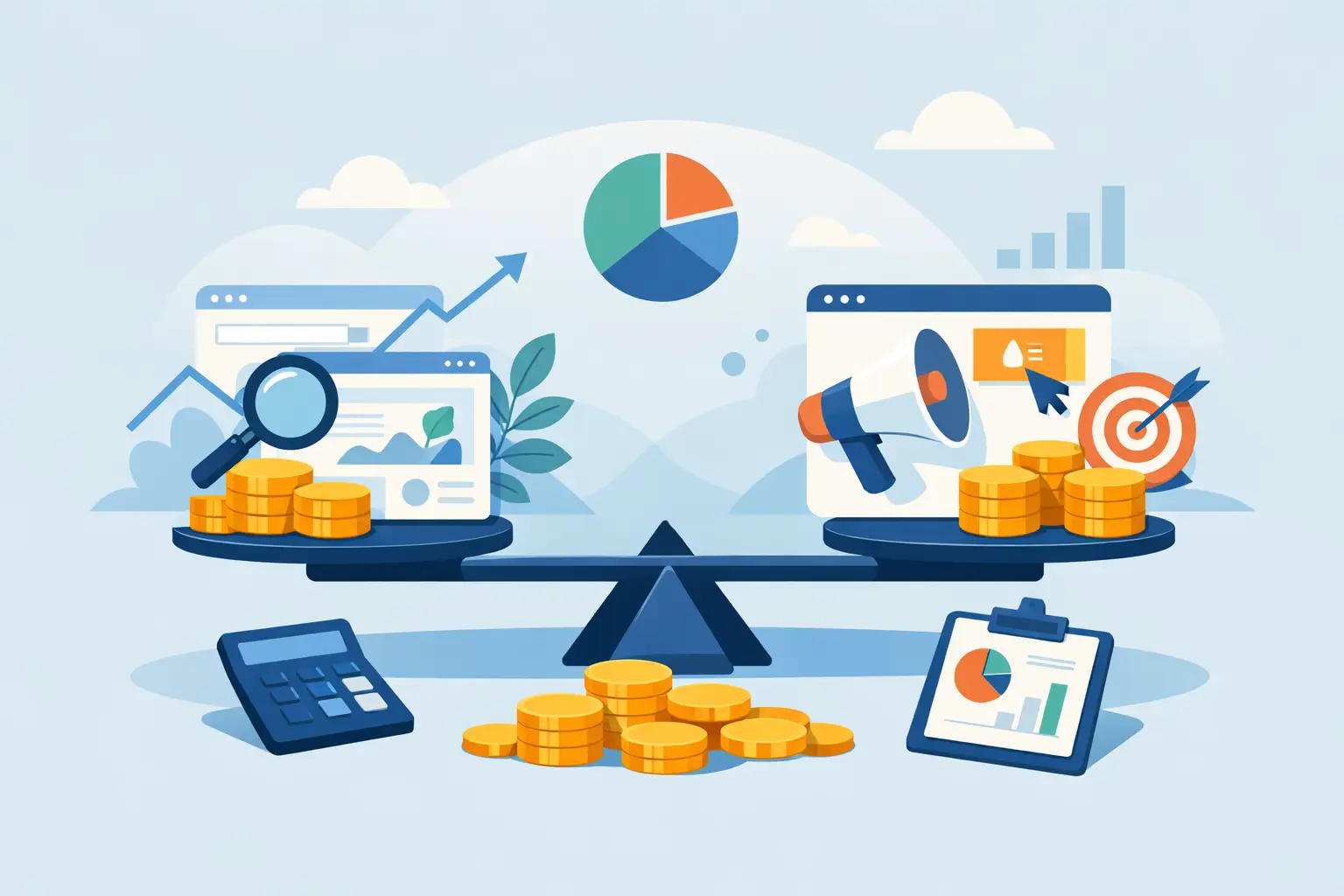
A better approach is to treat SEO and PPC as two different engines inside one growth system. One helps create durable visibility and lower acquisition costs over time. The other gives you speed, control, and immediate testing opportunities. The strongest budgets are not based on channel loyalty. They are based on business objectives, timing, and what your team can realistically support.
SEO vs PPC budgeting starts with business timing
Before you assign percentages, look at the pressure your business is under. If you need appointments, demos, or online sales quickly, PPC usually deserves a larger share at the beginning. Paid campaigns can put you in front of the right audience right away, which matters when cash flow, seasonality, or a product launch cannot wait six months.
If your business is stable enough to invest with a longer horizon, SEO becomes more valuable. It can improve your visibility across high-intent searches, support trust during the research phase, and reduce dependency on paid traffic over time. SEO rarely produces instant returns, but strong rankings and content can keep working long after the initial investment.
This is why timing matters more than broad rules like “always spend 50-50” or “put everything into organic first.” A newer business often needs PPC to create momentum while SEO is still gaining traction. A more established business may use PPC selectively while putting heavier investment into organic content, technical improvements, and conversion-focused site updates.
What SEO is really buying you
SEO is not just blog posts or keywords placed on a page. It is an investment in discoverability, authority, and long-term efficiency. When done well, it improves how your website performs in search, how clearly your expertise is communicated, and how often ideal buyers find you without a paid click.
Budgeting for SEO often includes technical cleanup, on-page optimization, content strategy, local optimization if relevant, reporting, and ongoing refinement. It can also include design or development work if your site has structural issues that hold back rankings or conversions. That is one reason SEO budgets sometimes feel harder to define than ad spend. You are not buying clicks. You are building an asset.
The trade-off is patience. SEO usually takes time before momentum shows up in traffic and lead volume. Results are also influenced by competition, website history, and how strong your current brand presence is. For a business owner who needs proof next month, that can feel uncomfortable. But for a business that wants sustainable growth, SEO often becomes one of the smartest places to invest.
What PPC is really buying you
PPC buys speed, targeting, and control. You can enter the market quickly, test messaging, target specific services, and shift budget toward what converts. It is especially useful when you need to validate offers, support a campaign, enter a new market, or fill short-term pipeline gaps.
PPC budgeting is easier to model because the inputs are more visible. You can estimate cost per click, expected click-through rate, landing page conversion rate, and target cost per lead. That makes paid search attractive for decision-makers who want a clearer forecast.
The trade-off is dependency. Once you stop paying, traffic usually stops too. PPC also becomes expensive fast in competitive industries, especially if the landing page experience, targeting, or follow-up process is weak. Paid media can absolutely drive strong ROI, but it can also magnify inefficiencies. If your website is unclear or your sales process is slow, more ad budget will not solve the underlying problem.
How to decide your SEO vs PPC budgeting mix
The most useful budget split is the one that matches your stage of growth.
If you are in an early growth phase, a heavier PPC investment often makes sense because you need visibility now. At the same time, a smaller but consistent SEO investment should still be in place so you are not forced to rely on ads forever. That might look like 60 to 70 percent toward PPC and 30 to 40 percent toward SEO for a period of time.
If you are in a more balanced growth phase, the split often becomes more even. This is common for businesses that already have some traffic and brand awareness but want both lead generation and stronger long-term positioning. A 50-50 or 60-40 split can work well, depending on competition and sales goals.
If you are in a mature phase with established authority, SEO may earn the larger share. In that case, PPC can become a precision tool used for branded protection, retargeting, high-value offers, or seasonal pushes. A 60-40 split favoring SEO is often reasonable when organic performance is already proving itself.
These percentages are not fixed rules. They are starting points. The right answer depends on your margins, average customer value, local or national competition, and how long a buyer takes to make a decision.
Budgeting mistakes businesses make most often
One common mistake is treating SEO and PPC as separate departments instead of connected strategies. In reality, paid search can reveal which keywords and offers convert fastest, and SEO can use that insight to shape content and landing pages. Organic performance can also guide ad copy, targeting, and audience intent. When the two channels inform each other, your budget works harder.
Another mistake is underfunding the basics. Businesses sometimes spend heavily on clicks while sending traffic to weak pages that do not explain the offer clearly. Or they invest in SEO content without addressing technical issues, user experience problems, or local search visibility. Budget allocation is not just about channel choice. It is about supporting the full path from search to conversion.
A third mistake is changing direction too quickly. SEO needs time. PPC needs testing. If you judge either channel too early, you can end up cutting the very investments that were about to start working. Good budgeting includes enough runway to gather meaningful data.
A practical way to build the budget
Start with revenue goals, not marketing tactics. If you know how many leads or sales you need, you can work backward into realistic acquisition targets. That makes it easier to determine how much PPC can profitably spend and how much SEO investment you can justify as a longer-term growth driver.
Next, examine your current baseline. Are you already getting organic traffic that could convert better with stronger pages and content? Are your paid campaigns generating leads, but at too high a cost? Are certain services more urgent to promote than others? Budgeting should reflect what is already happening, not just what sounds good in theory.
Then stage the investment. This matters for small and mid-sized businesses that cannot do everything at once. You may begin by using PPC to drive qualified traffic while improving key landing pages, then increase SEO investment as your site and content foundation strengthen. That phased model tends to be more manageable and more effective than trying to force every tactic into the first month.
This is also where a strategic partner can make a real difference. Tind-All Creative Marketing often helps businesses step back from channel-by-channel thinking and build a roadmap that aligns spend with growth priorities, internal capacity, and measurable outcomes. That kind of planning removes a lot of the guesswork.
When one channel should clearly lead
There are situations where the answer is not balanced at all. If you are launching a new service, entering a crowded market, or trying to recover from a sales dip, PPC may need to lead because speed matters. If your industry has strong search demand and your website has the potential to become a trusted resource, SEO may deserve a larger commitment because the long-term payoff is bigger.
The key is being honest about what problem you are solving first. If the immediate problem is lead volume, PPC often takes the lead. If the bigger problem is dependence on paid traffic and weak organic visibility, SEO needs more room.
Smart marketing budgets are not built around either-or thinking. They are built around momentum, sustainability, and the confidence to invest in both immediate wins and future strength. When your budget reflects that balance, your marketing stops feeling fragmented and starts acting like a system that can actually support growth.
The right split is the one that gives your business traction now without sacrificing where you want to be a year from now.